
MICSIG
MICSIG stands as a premier manufacturer and solution provider in the realm of signal testing and measurement equipment. Since its inception in 2012, the company has dedicated itself to the research and development of advanced technologies within the oscilloscopes and related products sector.
Each innovation from MICSIG is designed to transcend existing technical limitations and to investigate new avenues for the evolution of industry trends.

TABLET OSCILLOSCOPES
MICSIG introduced the world’s first full-touch tablet oscilloscope, which excels in performance and delivers an exceptional user experience.
Furthermore, MICSIG unveiled the groundbreaking SigtestUI™, the sole testing platform in the industry tailored specifically for test and measurement instruments, enhancing the functionality of professional tools by making them lighter, smarter, and more stable.

MHO 6 SERIES
The MHO High-Resolution Oscilloscope 6 Series is packed with impressive specifications: it boasts a 1GHz bandwidth, a sampling rate of 6GSa/s, and offers 8 analog channels. With a remarkable storage depth of 1800 million points (Mpts) and a vertical resolution of 12 bits, this oscilloscope is perfect for high-speed circuit analysis and synchronised signal testing. Its sleek design, measuring just 3.52 cm, allows you to maximise your workspace efficiently. The large 16-inch touch screen, with a stunning resolution of 1920*1200, ensures that you can view waveforms with exceptional clarity, enhancing your overall experience.

MHO 3 SERIES
The MHO 3 Series High Resolution Oscilloscope offers impressive capabilities with a 500MHz bandwidth and a sampling rate of 3GSa/s. It features four analog channels, an extensive memory depth of 360Mpts, and delivers 12 bits of vertical resolution. Its sleek 3.58cm ultra-thin design allows for versatile wall or arm mounting. Plus, the 14-inch integrated touchscreen with a resolution of 1920 x 1200 ensures an exceptional display for analysing waveforms.

ETO SERIES
The ETO series boasts the advanced SigtestUI™ multitasking system, ensuring seamless operation. With its sleek body protected by soft rubber, it features a 14-inch integrated touch screen that delivers stunning clarity at a resolution of 1920 x 1200 pixels, providing an ultra-clear waveform display unlike anything you've experienced before.

TO SERIES
Introducing the TO series of tablet oscilloscopes - your go-to solution for professional-grade measurements on the move. Equipped with a stunning 10.1-inch high-definition display, this portable oscilloscope boasts impressive features, including a built-in lithium battery that lasts over five hours. Choose between 2 or 4 channel options to suit your needs, with a maximum bandwidth of 300MHz and an incredible sampling rate of 2GSa/s. Plus, with a memory depth of up to 220Mpts, you can capture more data than ever before.

MDO SERIES
MICSIG's fifth-generation digital storage oscilloscope, the MDO series, has four analog channels, a bandwidth of 500MHz, a sampling rate of 3GSa/s, and a memory depth of 360Mpts. The most clear waveform display is offered by a 14-inch integrated touch screen with a resolution of 1920 x 1200.

STO SERIES
An 8-inch capacitive touch screen with 800x600 resolution, a maximum bandwidth of 200MHz, a sampling rate of 1GSa/s, and a memory depth of up to 70Mpts are all features of the MICSIG STO series oscilloscopes. These oscilloscopes have a waveform capture rate of 130,000 waveforms per second and support up to 4 analog channels. They have a broad range of measurement functions, sophisticated mathematical operation capabilities, and the ability to trigger and decode serial buses. Full touch control, full control panel operation, and a combination of touch and control panel operation are the three modes of operation that the series supports. The STO series offers an unmatched user experience when combined with MICSIG's proprietary touch algorithm patent technology and an intuitive operating system interface.

SATO SERIES
A specialised oscilloscope made for automotive diagnostics and maintenance is the SATO Series Automotive Diagnostic Oscilloscope. It has an 8-inch 800*600 resolution high-definition screen, a built-in lithium battery that lasts for more than five hours, 2/4 channel options with a maximum bandwidth of 200MHz and a sampling rate of 1GSa/s, and a number of professional features designed for automotive diagnostics. The maximum storage depth is 70 meters. You can set up different test projects with just one click thanks to its integrated automotive software package, which guarantees a worry-free diagnostic and measurement experience for your automotive work.

VTO / VATO SERIES
Install and run the oscilloscope Apk on any Android devices: smartphone, tablet, or Android PC, all signals on your fingertip.

SIGOFIT OPTICAL-FIBER ISOLATED PROBE
SigOFIT probe has highest common mode rejection ratio, or CMRR, up to 128dB at 100MHz, over 100dB at 1GHz. It's the ultimate referee of signal fidelity measured by other voltage probes.

ROGOWSKI AC CURRENT PROBE
The MICSIG RCP series Rogowski current probe is capable of measuring alternating currents up to 12,000 Apk, with a maximum bandwidth of 30 MHz. It can withstand voltages of up to 1 kVrms and features nearly zero insertion impedance, significantly reducing interference with the device under test (DUT).
Designed with a 1.6 mm thin and flexible clip-around Rogowski coil, this probe allows users to easily navigate around the pin legs of TO-220 semiconductor devices. With a typical accuracy of 2%, it effectively measures high-frequency and high-current signals, making it suitable for applications such as double-pulse dynamic testing and monitoring the current in semiconductor switches.

HIGH VOLTAGE DIFFERENTIAL PROBE
The MICSIG DP Series High-Voltage Differential Probes provide selectable bandwidths between 100MHz and 500MHz, accommodating a maximum differential input voltage of 7000Vpk. Their standard BNC interface guarantees compatibility with all leading oscilloscope brands. The probes are equipped with built-in metal shielding to improve anti-interference capabilities. With a slim design of just 2cm, they optimize workspace and include a one-click auto-zero feature for efficient setup. Additional functionalities comprise overload protection alarms and power-off memory, ensuring smooth operation. The high-impedance input and low input capacitance reduce loading effects, achieving measurement accuracy of ±2% and superior common-mode rejection (CMRR). These probes are particularly suitable for applications in electric vehicle power systems, solar inverters, switching power supplies, and testing floating or isolated high-voltage signals.

HIGH FREQUENCY AC/DC CURRENT PROBE
The MICSIG CP series high-frequency AC/DC current probe features a bandwidth of up to 100 MHz and incorporates a dual-range design of 5A and 30A. It is capable of measuring continuous currents of 30A and peak currents of 50A with an accuracy of 1%. The probe offers a resolution of up to 1mA, boasts a high signal-to-noise ratio, and performs demagnetization and Auto-Zero functions simultaneously. Its overload protection ensures rapid and precise signal capture, making the CP series an excellent option for measuring small currents. With its compact and elegant design, it is user-friendly and includes a standard BNC interface, allowing compatibility with any oscilloscope.

CP2100 SERIES
The CP2100 series is a versatile current probe designed for both DC and AC applications. Featuring a split design and an aesthetically pleasing appearance, it utilizes a BNC connector, making it compatible with oscilloscopes and multimeters. The probe can handle a maximum current of 100Apk (70.7Arms) and is available in two models: the CP2100A, which operates from DC to 800kHz, and the CP2100B, which functions from DC to 2.5MHz, with current ranges of 10A and 100A. It includes both automatic and manual zero adjustment, is powered via USB, and is suitable for use in motor drives, power frequency applications, inverters, and more.

ACP1000 SERIES
The ACP1000 AC current probe is designed for measuring alternating current. It offers bandwidth ranging from 10Hz to 100kHz and can measure currents up to a maximum of 1000A with an accuracy of 1%. Featuring a standard BNC interface, it is compatible with oscilloscopes from all manufacturers. The probe includes three adjustable range settings of 10A, 100A, and 1000A, and its clamp design allows for a jaw diameter of up to 52mm. It operates without the need for an external power supply, making it portable and user-friendly. Constructed from high-quality, durable materials, it is commonly utilized in applications such as motor drives, inverters, switching power supplies, and avionics.

We're here to help
Talk to an expert today.
Our friendly team of highly trained specialists will quickly assist you.
We promise to respond within 4 business hours (AEST).
Or you will receive $100 off your next purchase. Read how it works.

Our Experience
We offer you advice that is gained from many years of assisting people from all industries with their individual requirements, technical objectives and challenges.
most advanced solutions
The Ametek stable of brands the are industry's greatest innovators, always being the first to release new technologies & features.
Satisfaction guarantee
We work hard to ensure that you are very happy with every aspect your new test equipment solution and provide the most attentive after-sales care in the industry.
Top FAQs
Electrostatic discharge (ESD) is the sudden flow of electricity between two electrically charged objects caused by contact, an electrical short, or dielectric breakdown. A buildup of static electricity can be caused by turbocharging or by electrostatic induction.
Simulates electrostatic discharge events directly to the product, or to a nearby conductive surface.
Test Method
The ESD test requires that discharges be made to all exposed surfaces of the EUT, including connector back shells. Contact discharge is to the conducting surfaces of the product and air gap discharges are to non-conducting surfaces. The test also requires that contact discharges be made to a horizontal reference plane and vertical reference plane at locations 10cm from the front, rear and sides of the EUT. The ESD Simulators/Generators/Guns can be used for ESD Testing.
Typical rise time of the ESD pulse waveform is approximately 0.7 - 1nS with a hold time of 30 - 60 nS. (See image)
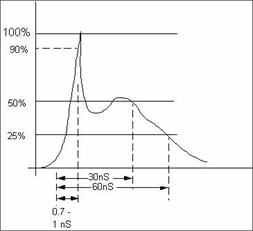
The test simulates ESD events that occur when the user touches the equipment under test or nearby metallic objects (e.g. filing cabinets). The test levels for both the heavy industrial and light industrial/commercial/residential standards are ±2kV and ±4kV for the contact discharge method and ±2kV, ±4kV, and ±8kV for the air gap discharge method.
A transient event is a short-lived burst of energy in a system caused by a sudden change of state. The source of the transient energy may be an internal event or a nearby event. The energy then couples to other parts of the system, typically appearing as a short burst of oscillation.
In electrical and electronic engineering such electromagnetic pulses (EMP) occur internally as the result of the operation of switching devices. Engineers use voltage regulators and surge protectors to prevent transients in electricity from affecting delicate equipment. External sources include lightning (LEMP), electrostatic discharge (ESD) and nuclear EMP (NEMP).
Within Electromagnetic compatibility testing, transients are deliberately administered to electronic equipment for testing their performance and resilience to transient interference. Many such tests administer the induced fast transient oscillation directly, in the form of a damped sine wave, rather than attempt to reproduce the original source. International standards define the magnitude and methods used to apply them.
Simulates high frequency electrical disturbance on power and signal lines due to the switching of inductive loads on the AC line.
Test Method
The test waveform consists of a 15ms burst of pulses at 300ms intervals. The pulses have a rise time of 5ns and a dwell time of 50ns, with a repetition rate of 5 kHz.
For heavy industrial equipment the test levels are:
- AC lines; ±2kV
- DC lines;
- ±2kV Signal lines on cables that could be longer than 3m; ±1kV
- Process control lines and measurement lines; ±2kV
Noise is directly injected onto power lines through a capacitor and capacitive coupled onto I/O lines using a coupling trench. DC power ports connected to an AC-DC power adapter are not tested.
Surges, or transients, are brief overvoltage spikes or disturbances on a power waveform that can damage, degrade, or destroy electronic equipment within any home, commercial building, industrial, or manufacturing facility. Transients can reach amplitudes of tens of thousands of volts.
Simulates low frequency, high-energy electrical transients on power lines and long distance I/O lines (such as telephone lines) coupled from nearby lightning strikes.
Test Method
Test is applied to AC and DC power ports. The open circuit signal wave-shape has as 1.2µs rise time and 50µs hold time. Surges are applied in common mode (line-to-ground) and in differential mode (line-to-line). All surges are synchronized to the 0°, 90°, 180° and 270° phase angles of the AC voltage. DC power ports are not tested if they are connected to an AC-DC power adapter, in which case the AC-DC adapter should be submitted for testing.
Test levels for the residential, commercial and light industrial generic standard are 2kV common mode and 1kV differential mode on AC power lines. For DC power lines, the test levels are 0.5kV for both differential and common mode. Although the test is not currently required for the heavy industrial generic standard, it suggests test levels of 4kV common mode and 2kV differential mode.
Simulates brown outs and blackouts on AC power lines.
Test Method
This test is applied to AC power ports rated at less than 16 amps per phase. All voltage shifts are synchronized to the zero crossing of the AC voltage.
Typical test levels for the generic light industrial standard involve a 30 percent dip in the line voltage for 10ms, 60 percent dip for 100ms and dropout for 5000ms. There are currently no requirements for Heavy Industrial equipment.
All linear amplifier systems, when given a sufficiently strong input signal, will reach a point where the system departs from a linear relationship between input and output. At this point the system is said to be going into compression or beginning to saturate. Beyond this point, the linear relationship between input and output is no longer valid and the amplifier is no longer considered to be linear. An internationally recognised figure of merit, used for defining the extent of linearity of an amplifier, is the 1dB compression point. This is the point of –1dB departure from linearity. The output power of an amplifier cannot increase indefinitely and when an increase in input power generates no discernible increase in output power, the amplifier is said to be saturated, and by definition the output is not proportional to the input signal. This point is often referred to as Psat on a datasheet or sometimes P3dB. Generally, saturated power is of importance when considering the pulsed power requirements in something like automotive testing while linear power is of importance when considering the AM (amplitude modulation) waveform used in commercial EMC testing.

Thank you for helping our team select the correct product to facilitate testing to the various required standards. Our lab is now equipped with a range of Teseq, IFI and Milmega products and the entire solution fulfils our testing requirements. We really appreciate your technical advice & support.
Scott Emerson
EMC TEST ENGINEER

Aside from receiving information when we need to upgrade or purchase an item of test equipment, what we really need from an equipment partner is advice based on industry experience. Thank you for the many hours spent talking to us and answering our questions. This level of customer care is rare in this industry.
Janet Boyle
EMC TEST ENGINEER TEAM LEADER

The Teseq GTEM is a great testing tool to have. We are now performing all pre-compliance testing in-house and saving lots of money which we were spending earlier with test labs. It has given us significant more testing capability and flexibility. Thank you for your help.
Sue Benton
TECHNICAL DIRECTOR
Technical Support
Our experts are all pre-eminent leaders in electrical products who provide excellent support in their areas of expertise.
Technical supportTalk to an expert
Our friendly team are highly trained product experts who really enjoy helping customers find what they need.
call 1300 387 326Enquire by email
We promise to respond within 4 business hours (AEST) or you will receive $100 off your next purchase.
Enquire now